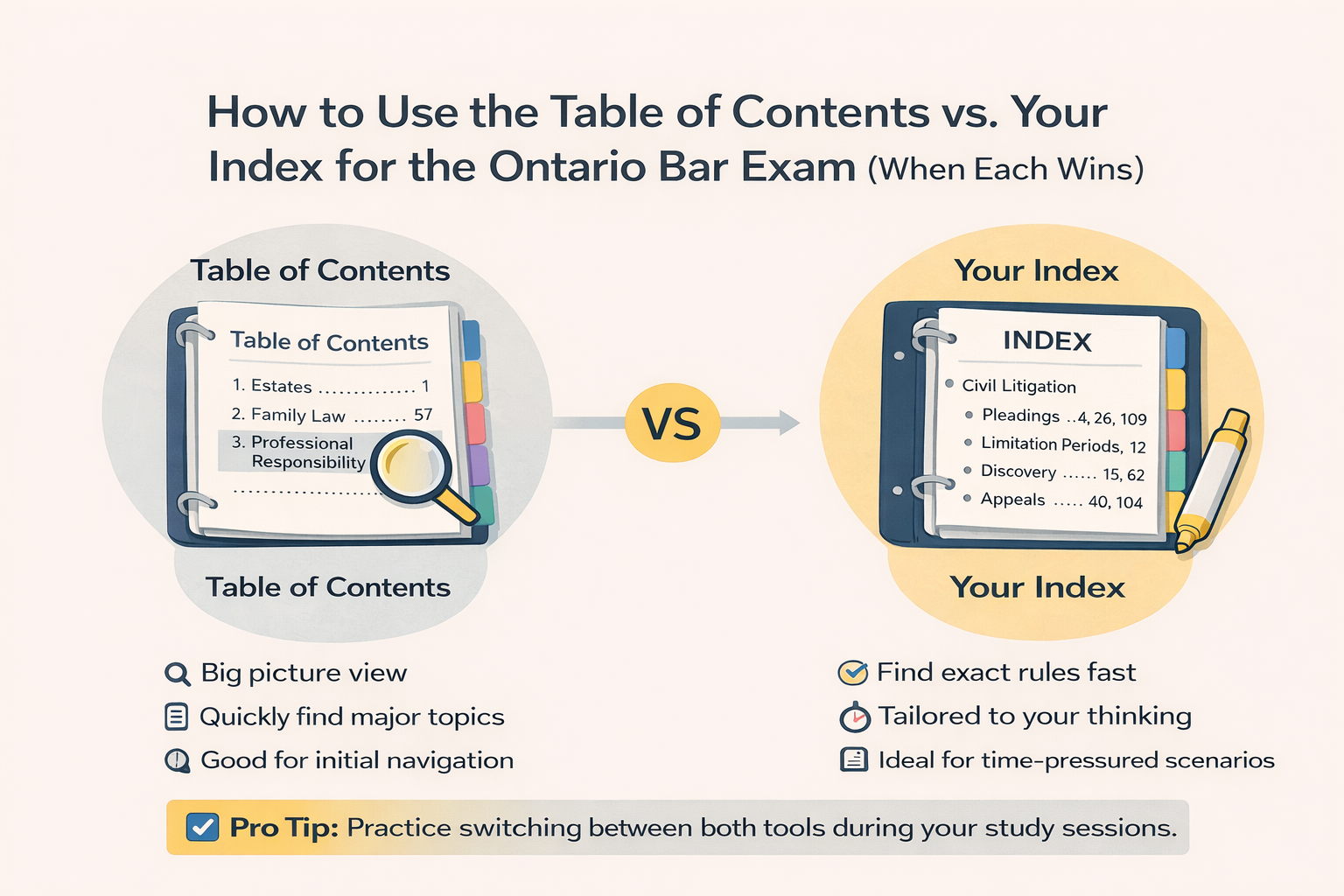
Preparing for the Ontario Bar Exam isn’t just about memorizing content — it’s about knowing how to quickly access the right information during the exam. Two tools stand out: the official Table of Contents (TOC) in your materials and your personalized index. But when should you rely on one over the other? Here’s the guide.
1. Understanding the Table of Contents
The official TOC is your roadmap. It’s structured by topics and chapters, giving you a top-level view of the materials.
When it wins:
- Quickly locating major topics: For example, if you need to check the rules on Estates or Professional Responsibility, the TOC quickly directs you to the right section.
- For broad review: During your first skim or orientation, the TOC helps you see how materials are organized.
Limitations:
- Not detailed enough for specific rules or subtopics.
- Slower if you need a very specific subsection in the heat of the exam.
2. Building Your Own Index
Your personal index is a cheat sheet tailored to your study habits. Include page references, alternative names for rules, or cross-references.
When it wins:
- Fast lookups: For complex fact patterns, your index allows you to go straight to the rule without scanning dozens of pages.
- Time-sensitive questions: Open-book exams reward speed. Your index is designed to save crucial minutes.
- Highlight weak areas: Track which rules you often forget or misapply, and flag them for instant retrieval.
Limitations:
- Takes time to build and maintain.
- Can be overwhelming if too detailed or inconsistent.
3. Combining Both Tools
The real strategy is using both intelligently:
- TOC for orientation: Navigate big sections and confirm you’re in the right chapter.
- Your index for precision: Once in the right area, your index directs you to the exact rule, case, or page you need.
Pro Tip: Practice navigating between TOC and your index during timed drills. This dual approach maximizes speed and accuracy.
4. Tips for Effective Indexing
- Keep your index concise: 1–2 pages per major section.
- Use clear labels for alternative rule names.
- Highlight frequently tested areas for instant access.
- Update weekly as you identify gaps in your knowledge.
Final Thoughts
Knowing when to use the TOC and when to rely on your index can be the difference between finishing the exam on time and losing points to slow navigation. Build your system early, practice it often, and watch your speed and confidence improve.