
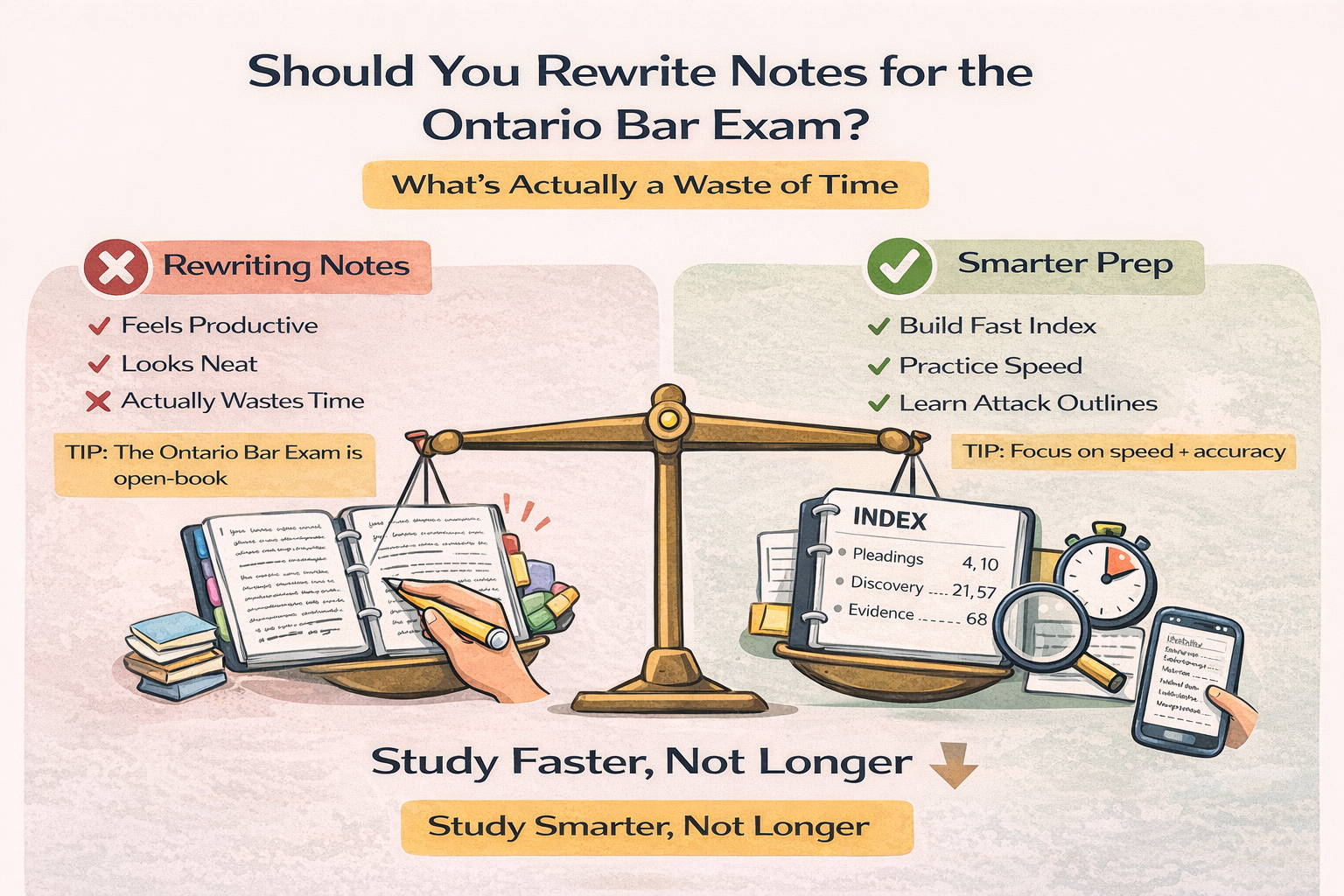
Should You Rewrite Notes for the Ontario Bar Exam? What’s Actually a Waste of Time

January 5, 2026

Rewriting notes is one of the most common study habits law students rely on. It feels productive. Your pages look neat. You’re busy for hours.

But here’s the uncomfortable truth for Ontario Bar Exam candidates:

Rewriting notes is one of the biggest time-wasters for the Ontario Bar Exam.

This article explains when rewriting notes helps, when it hurts, and what you should be doing instead if your goal is to pass.

Why Rewriting Notes Feels Productive (But Often Isn’t)

Rewriting notes gives you:

  • A sense of control
  • Clean, organized material
  • Comfort during stressful prep

But the Ontario Bar Exam is:

  • Open-book
  • Time-pressured
  • Index-dependent

The exam does not test how well you remember content — it tests how fast you can find and apply it.

The Real Goal of Ontario Bar Exam Prep

Your priority is not memorization.

Your priority is:

  • Navigating materials quickly
  • Knowing where information lives
  • Applying rules efficiently under time pressure

If an activity doesn’t improve speed + accuracy, it’s likely a waste of time.

When Rewriting Notes Is a Waste of Time

Rewriting notes is usually a bad idea if:

  • You’re copying text word-for-word
  • You’re rewriting summaries you already understand
  • You’re rewriting instead of practicing questions
  • You’re behind schedule
  • You already have official materials

In these cases, rewriting notes gives comfort, not results.

When Rewriting Notes Can Help (Limited Cases)

Rewriting notes may help only if:

  • You’re creating a condensed attack outline
  • You’re simplifying rules into your own words
  • You’re restructuring content for faster scanning
  • You’re building a custom index reference

Even then, this should be:

  • Short
  • Targeted
  • Purpose-driven

Not full rewrites.

What You Should Do Instead (High-ROI Strategies)

1. Build a Strong Index

Your index is your biggest weapon.

Focus on:

  • Clear headings
  • Consistent terminology
  • Fast lookup cues

A strong index beats perfect notes every time.

2. Practice Navigating Materials

Instead of rewriting:

  • Open a practice question
  • Find the rule using your materials
  • Time how long it takes

Speed improves through repetition, not rewriting.

3. Use the First Pass / Second Pass Method

  • First pass: Answer what you know fast
  • Second pass: Look up tougher issues using your index

This mirrors real exam conditions.

4. Track Weak Areas

Use tools like BarBuddy to:

  • Identify slow topics
  • Track performance
  • Adjust focus intelligently

Guessing what you need to improve wastes time.

The Biggest Time-Wasters for Ontario Bar Exam Prep

Avoid these:

  • Rewriting entire summaries
  • Color-coding obsessively
  • Perfecting formatting
  • Passive reading
  • Studying without timing yourself

If it doesn’t improve speed or accuracy, cut it.

Final Verdict: Should You Rewrite Notes?

Most of the time — no.

If you’re short on time, rewriting notes is one of the worst uses of your energy.

Instead:

  • Practice finding rules
  • Improve index navigation
  • Focus on exam execution

That’s how you pass the Ontario Bar Exam.

Study Smarter, Not Longer

BarBuddy helps Ontario bar candidates focus on what actually matters speed, structure, and strategy.

Get started at BarBuddy.ca